
 English
 Pусский
 Deutsch
 日本語
日本語 한국어
한국어 हिन्दी
 Indonesia
 Melayu
 Tiếng Việt
Reactor fotoquímico de flujo continuo
A Continuous Flow Photochemical Reactor is a specialized system designed to carry out light-driven chemical reactions under a continuous processing mode. Unlike traditional batch reactors, where reagents are combined and irradiated in a single vessel, a continuous flow reactor moves the reaction mixture through a controlled channel or tubing system while exposing it to a specific light source. This approach offers significant advantages in safety, efficiency, scalability, and reaction control, making it an important technology in modern chemical manufacturing and research.The basic principle of a continuous flow photochemical reactor is relatively simple. A solution containing the reactants is pumped at a carefully controlled rate through a transparent or light-permeable reactor zone. During this passage, the reaction mixture is irradiated by ultraviolet, visible, or near-infrared light, depending on the photochemical transformation being performed. Because the fluid is continuously refreshed and the path length is often short, light can penetrate more uniformly than in large batch vessels. This improves reaction consistency and often leads to higher yields and cleaner products.One of the main benefits of continuous flow photochemistry is enhanced control over reaction conditions. Parameters such as residence time, flow rate, temperature, pressure, and light intensity can be adjusted precisely. This allows chemists to optimize a reaction more easily and reproduce results with high reliability. Short residence times can reduce unwanted side reactions, while improved heat dissipation helps prevent overheating and degradation of sensitive compounds. In addition, the small internal volume of the reactor reduces the amount of hazardous material exposed to light at any given time, which improves operational safety.Continuous flow photochemical reactors are widely used in organic synthesis, pharmaceutical development, fine chemical production, and materials science. They are especially useful for reactions that require strong irradiation, rapid mixing, or highly controlled exposure to light. Common applications include photoredox catalysis, photoisomerization, halogenation, cycloaddition, and oxidation reactions. These systems are also valuable for studying reaction mechanisms, screening conditions, and scaling up laboratory processes to pilot or industrial production.The design of a continuous flow photochemical reactor may include features such as LED or laser light sources, cooling systems, reflective housings, transparent reaction channels, pumps, and inline monitoring tools. Some systems use microchannels or narrow tubing to maximize light penetration, while others employ modular configurations for flexible operation. Inline analytical tools, such as UV-Vis spectroscopy or chromatography sampling, can be integrated to monitor reaction progress in real time.Overall, a continuous flow photochemical reactor represents a powerful and modern platform for performing light-induced chemistry. By combining efficient irradiation with precise flow control, it enables safer, faster, and more scalable photochemical processes. As the demand for sustainable and high-performance chemical manufacturing continues to grow, continuous flow photochemical technology is expected to play an increasingly important role in both academic research and industrial production.
Producto
Categoría:
-
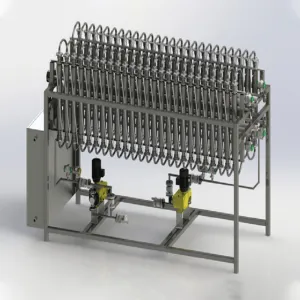
Reactor fotoquímico de flujo continuo
Su clasificación: Reactores fotoquímicos de flujo continuoVistas: 839Número:Tiempo de liberación: 2026-07-11 15:42:05El fotorreactor de flujo continuo integra profundamente reacciones fotoquímicas con procesos de flujo continuo. Acorta el camino óptico desde el nivel centimétrico de los reactores de caldera tradicionales hasta el nivel milimétrico o micrométrico, aumentando en gran medida la tasa de utilización de fotones y la eficiencia de la reacción. Respaldados por una estructura precisa de múltiples canales paralelos/en serie, los reactivos fluyen de manera continua y constante bajo una iluminación uniforme para lograr una doble mejora de la transferencia de masa y calor, brindando soluciones confiables de grado industrial para las industrias farmacéutica, de química fina y de nuevos materiales.
Noticias
Categoría:
-
[Blog]Guía de optimización de la fuente de luz del reactor fotocat...
2026-08-03 03:06:27
Caso
Categoría:
¡Sin resultados de búsqueda!
Video
Categoría:
¡Sin resultados de búsqueda!
Descargar
Categoría:
¡Sin resultados de búsqueda!
Reclutamiento
Categoría:
¡Sin resultados de búsqueda!
Productos recomendados
-
NEWS
Reactor fotoquímico de flujo continuo
Conozca más



 Whatsapp
 Teléfono